



 Phone
 Send Email
 Whatsapp




What is SMC (Sheet Molding Compound)? Complete Material Guide
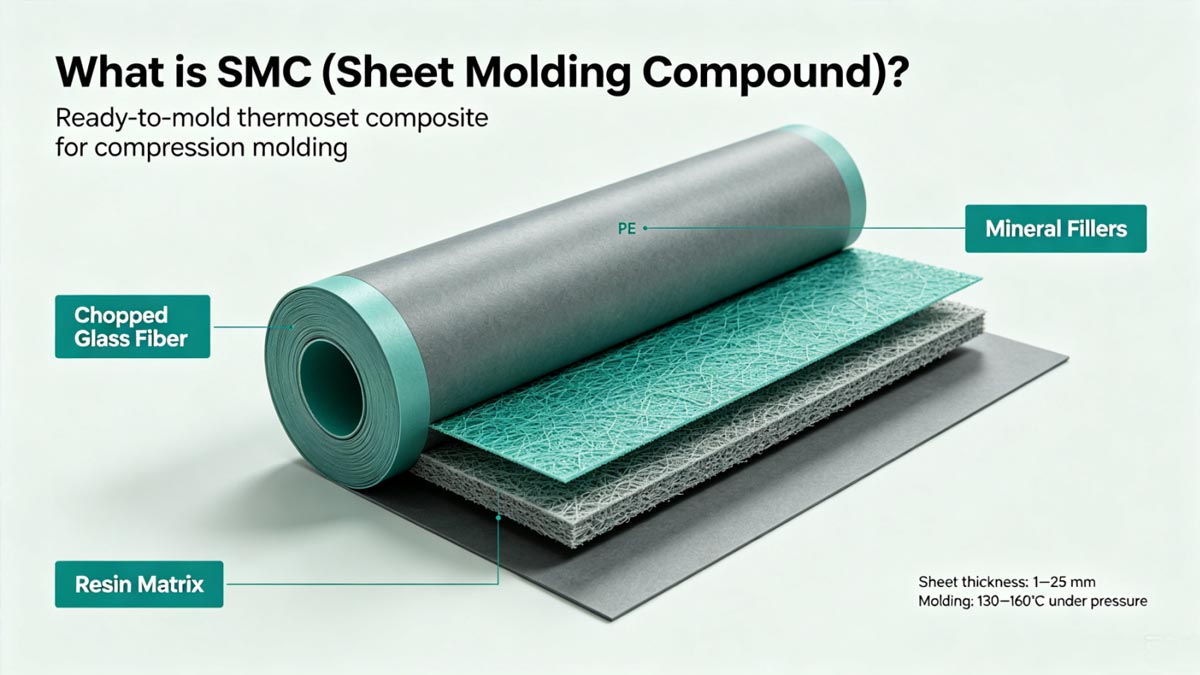
SMC (Sheet Molding Compound) is a ready-to-mold thermoset composite sheet consisting of 25-35% chopped glass fibers (12- 50 mm), unsaturated polyester or vinyl ester resin, mineral fillers, and additives. Supplied in 1- 25 mm thick sheets between carrier films, it cures in 1-5 minutes at 130-160°C under compression molding, delivering a high strength-to-weight ratio, dimensional stability, and Class A surface capability for automotive, electrical, and industrial applications.
Article Guide:
• Standard definition of SMC material, core components, and how each ingredient affects final performance
• Complete SMC sheet manufacturing process and the critical role of maturation in part quality
• Performance differences, application scenarios, and cost comparisons across six SMC material types
• Essential distinctions between SMC, BMC, FRP, and sheet metal — plus a framework for material selection
• Four-step evaluation method for reverse-engineering material selection from part characteristics, including common pitfalls
What Is SMC (Sheet Molding Compound)?
A standard definition, basic form, and industry positioning of SMC — foundational knowledge for effective technical communication with suppliers.
SMC is a pre-impregnated sheet-like composite semi-finished product — a molding material that is pre-compounded and ready to form through the application of heat and pressure. It is not a finished part, but rather an intermediate material used to produce parts.
According to ISO 8605:2024, SMC (Sheet Molding Compound) is a sheet-like molding compound consisting of resin uniformly mixed with chopped and/or continuous reinforcing fibers, typically ranging in thickness from 1mm to 25mm, which can be cured by compression molding under heat and pressure.
In simpler terms, SMC is produced by uniformly pre-mixing glass fibers, resin, fillers, and various functional additives at the material manufacturing facility, pressing them into continuous sheets, covering both sides with PE film, and supplying them in rolls. End users receive the material ready to use — no on-site compounding is required. Simply remove the film, cut to size, place into a heated mold, and within minutes, a finished part is produced. At Yongchao, our factory in Jiangmen handles the entire production process from SMC sheet compounding to molded parts.
A common question from customers: Is SMC a plastic? This cannot be answered with a simple yes or no. From a technical classification perspective, SMC belongs to the thermoset composite family and has fundamental differences from common thermoplastics (such as PP, ABS, etc.):
- Thermoplastics melt upon heating and can be reshaped repeatedly; SMC, once cured, becomes infusible and insoluble — it cannot be remelted or reshaped
- The strength of thermoplastics comes from the material itself; SMC achieves reinforcement through the composite effect of glass fibers and the resin matrix, delivering significantly higher strength and rigidity per unit weight than plastics
- Thermoplastics are primarily processed by injection molding and extrusion; SMC is predominantly compression molded, making it more suitable for large-sized, high-strength parts
Therefore, the accurate description is: SMC belongs to the fiber-reinforced thermoset composite family and is a branch of FRP (Fiber Reinforced Polymer/Plastic). Its defining characteristics are supply in pre-impregnated sheet form and processing via compression molding. For a systematic understanding of the complete process from SMC material to finished parts and the scope of services available, please refer to our full SMC molding service overview, covering everything from material compounding and mold design to both primary molding processes.
Core Composition of SMC Material
SMC may appear to be a simple sheet material, but it is actually a sophisticated formulation system. Understanding the functions and ratios of the four major components enables precise technical communication with suppliers.
From the outside, SMC looks like just a gray-green sheet, but its internal formulation is highly complex. The selection and proportion of each ingredient directly affect the final part's strength, surface quality, temperature resistance, and cost. At Yongchao, our engineering team tailors formulations around the following four major components when working on material selection for clients:
Resin Matrix (25-35%)
The resin is the matrix of SMC, serving to bond glass fibers and fillers while providing chemical resistance and electrical insulation properties. Three resin systems are commonly used:
- Unsaturated Polyester Resin (UPR): The most mainstream and cost-effective option, accounting for over 80% of SMC usage. It offers balanced overall performance and is suitable for most general applications in automotive, electrical, and construction industries.
- Vinyl Ester Resin: Offers superior corrosion resistance and temperature performance at a higher cost. Commonly used in chemical equipment, anti-corrosion piping, battery enclosures, and other demanding environments.
- Epoxy Resin: Provides the highest mechanical properties and adhesive strength but cures more slowly and requires tighter process control. Primarily used in aerospace and high-end structural components.
Reinforcement Fibers (25-35%)
Fibers serve as the load-bearing skeleton of SMC and are the primary source of material strength. Without fiber reinforcement, the resin is merely a brittle matrix.
- E-Glass Fibers: The most commonly used reinforcement, with fiber lengths typically ranging from 12- 50 mm. Longer fibers deliver higher strength but reduce material flowability — the optimal length depends on the part geometry.
- Carbon Fibers: A high-end reinforcement option offering over 30% weight reduction compared to glass fibers and 2-3 times higher strength, but at 5-10 times the cost. Primarily used in supercars and aerospace applications.
- Fiber Content: Standard SMC typically contains 25-30% glass fiber, while high-strength grades can reach 50-60%. Higher content improves strength but increases cost and molding difficulty — trade-offs are required.
Fillers (20-40%)
Fillers are often misunderstood as cost-cutting measures, but they are an essential part of formulation design, serving both to reduce costs and enhance specific properties:
- Calcium Carbonate (CaCO3): The most common filler, reducing costs while improving material rigidity and surface hardness.
- Aluminum Hydroxide (ATH): Functions as both a filler and a flame retardant — a standard component in electrical-grade SMC that significantly improves flame retardancy and arc resistance.
- Talc, Hollow Microspheres: Used to reduce density or modify rheological properties as required.
Functional Additives (5-10%)
Though additives account for a small percentage, each plays a distinct and critical role:
- Curing Agents/Initiators: Regulate the curing reaction rate of the resin under heating conditions.
- Thickeners: Gradually increase SMC viscosity from a paste-like state to an elastomeric state, facilitating cutting and molding operations.
- Low-Profile Additives (LPA): Counteract resin curing shrinkage to achieve low-profile or even zero-shrinkage — a key technology for achieving Class A surfaces.
- Release Agents: Prevent parts from adhering to the mold, ensuring production stability.
- Pigments/Color Pastes: Allow for in-material coloring during compounding, producing finished parts in the desired color without painting — offering significant cost savings for high-volume, single-color production.
- Flame Retardants, UV Stabilizers, Antistatic Agents: Added as needed to meet specific industry requirements.
How SMC Sheet Is Manufactured
SMC sheet production involves multiple precision-controlled processes. Below is a step-by-step walkthrough from raw materials to finished sheet, with special emphasis on the maturation period — a frequently overlooked but critical factor in part quality.
Many customers assume SMC is simply a mixture of resin and fibers pressed into sheets, but the actual production process is far more complex. A complete SMC production line spans several dozen meters, with each process requiring precise control. Yongchao operates its own SMC compounding line in Huizhou; the general production process is as follows:
Step 1: Resin Paste Preparation
The first step is preparing the resin paste. All liquid and powder components — resin, fillers, curing agents, thickeners, release agents, pigments, etc. — are weighed according to the formulation and fed into a high-speed disperser for thorough mixing to form a uniform paste system. The key here is dispersion uniformity — agglomerated fillers or poorly dispersed additives will directly cause performance fluctuations and batch-to-batch variations in the final sheet.
Step 2: Film Carrying and Paste Coating
The upper and lower PE (polyethylene) films are unwound from their rolls to serve as carriers. The resin paste is precisely applied to the surface of the lower film using a doctor blade, with coating thickness accurately controlled from a fraction of a millimeter to several millimeters.
Step 3: Fiber Chopping and Deposition
Glass fiber rovings are drawn from creels and cut to specified lengths (commonly 12mm, 25mm, or 50mm) by a cutting device. The chopped fibers are randomly dispersed onto the lower film coated with resin paste. Control over fiber length and deposition density directly determines the final sheet's fiber content and distribution uniformity.
Step 4: Sandwiching and Impregnation
The upper film is applied to form a "resin paste + fibers + resin paste" sandwich structure. The sheet is then compressed to the specified thickness through a series of calendar rolls, ensuring thorough impregnation of the fibers by the resin paste. This impregnation step is the core process of the entire production line — insufficient impregnation results in "dry spots" that directly compromise part strength.
Step 5: Winding and Maturation
After impregnation, the sheet is wound into rolls and placed in a temperature- and humidity-controlled maturation room for 48-72 hours. During this period, the thickener chemically reacts with the resin, gradually increasing the sheet's viscosity from a paste-like state to an elastomeric state. It is at this point that the SMC reaches its optimal processing condition.
This is a stage that many purchasers tend to overlook. Freshly produced SMC is too soft for convenient cutting; if stored too long, excessive thickening reduces flowability. Each batch of SMC has an optimal usage window — typically from 1 week to 3 months after maturation is complete. At our factory, we verify the production date and maturation status of each batch before scheduling production, ensuring that expired materials are not used. This is one of the key reasons why seemingly identical materials can produce parts of vastly different quality when processed by different manufacturers.
After maturation, the PE film is removed, and the SMC is cut to mold cavity dimensions as charges, which are then placed into heated compression molds and formed under hydraulic press pressure. For detailed information on compression molding parameters, our 21 hydraulic presses' tonnage configurations, and maximum molding dimensions, please refer to our SMC compression molding manufacturer service page, which includes complete equipment specifications and capability parameters.
Key Material Properties and Performance
Hard parameters commonly used by procurement and engineering professionals for material selection, covering four dimensions: mechanical, thermal, electrical, and chemical resistance. The values listed are typical ranges — actual project data should be based on specific testing.
When evaluating SMC materials, performance parameters are the core basis for decision-making. Below are typical performance ranges for standard SMC, derived from industry-standard test methods and our internal laboratory validation. These are reference ranges; actual values vary by formulation.
Mechanical Properties
- Density:1.7-1.9 g/cm³ — approximately 1/4 that of steel and 2/3 that of aluminum, offering significant lightweighting advantages
- Tensile Strength:60-100 MPa; high-strength grades can reach 150-250 MPa
- Flexural Strength:120-220 MPa
- Flexural Modulus:7-12 GPa
- Impact Strength (Charpy):30-80 kJ/m²
- Molding Shrinkage:0.05-0.3%; low-profile formulations can achieve <0.05%, approaching zero shrinkage
Thermal Properties
- Heat Deflection Temperature (HDT):180-240°C, varying by resin system
- Continuous Service Temperature:-50°C to 150°C for general-purpose grades; specialty formulations can exceed 200°C
- Coefficient of Thermal Expansion:10-20 × 10⁻⁶ /°C — significantly lower than most thermoplastics, providing excellent dimensional stability
- Flame Retardancy Rating:Standard grades UL94 HB; flame-retardant formulations can achieve UL94 V-0
Electrical Properties
- Dielectric Strength:10-20 kV/mm
- Volume Resistivity:10¹² - 10¹⁵ ohm-cm
- Arc Resistance:120-180 seconds (electrical-grade formulations)
- Comparative Tracking Index (CTI):250-600V
Chemical Resistance
- Acid Resistance: Good — stable against most weak and dilute acids
- Alkali Resistance: Moderate — vinyl ester resin systems are recommended for strong alkaline environments
- Organic Solvent Resistance: Good — insoluble in most organic solvents
- Weather Resistance: Long-term outdoor use is possible with UV stabilizers, suitable for construction and new energy exterior components
Again, these are typical ranges. One of SMC's core advantages is formulation customizability — increase fiber content for higher strength, add ATH and flame retardants for flame resistance, or use low-shrinkage systems for high surface quality.
Types of SMC and Their Use Cases
SMC is a material family rather than a single material, with price differences between types that can range by several multiples. Understanding the classifications and application scenarios is a prerequisite for accurate selection and cost control.
Many clients new to SMC wonder: Why do materials all called "SMC" have such wide price variations? The answer lies in the fact that SMC is a material family — different formulation systems correspond to entirely different performance levels and price points. For procurement professionals, clear classification is the first step toward accurate selection.
H3 Standard SMC (General Purpose)
The most basic and highest-volume category. With 25-30% glass fiber content, unsaturated polyester resin, and calcium carbonate filler, it offers balanced performance at a moderate price — the first choice for most structural components and housings.
- Typical Applications: Electrical enclosures, architectural components, seat frames, general industrial parts
- Positioning: The best cost-performance mainstream grade
High-Strength SMC / HMC
Glass fiber content increased to 50-65%, with some specifications using unidirectional fiber layup (HMC — High-strength Molding Compound). Flexural strength can exceed 250 MPa, 2-3 times that of standard grades.
- Typical Applications: Automotive structural parts (engine cradles, leaf springs), heavy-duty brackets, aerospace secondary structures
- Note: Higher fiber content significantly increases both material cost and molding difficulty — the most economical solution that meets performance requirements should be selected.
Low-Profile / Class A SMC
Low-profile additives (LPA) are incorporated to control molding shrinkage below 0.05%, resulting in extremely smooth, flat surfaces that can be directly painted as automotive exterior parts or even achieve a paint-free finish.
- Typical Applications: Automotive hoods, trunk lids, fenders, high-end appliance housings
- Note: Class A SMC requires exceptionally high mold surface finish and process control — suppliers must have proven experience in mass-producing automotive exterior parts.
H3 Flame-Retardant / Electrical Grade SMC
Heavy loading of ATH and flame retardants achieves UL94 V-0 flame retardancy combined with excellent dielectric properties, arc resistance, and tracking resistance — the primary grade for the electrical industry.
- Typical Applications: High-voltage switchgear, circuit breaker housings, insulators, battery enclosures, new energy insulation structural components
- Note: High flame retardant content affects mechanical properties — selection requires balancing strength and flame resistance.
Carbon Fiber SMC (CF-SMC)
Carbon fibers replace glass fibers as the reinforcement, delivering lighter weight, higher strength, and higher modulus at significantly higher cost.
- Typical Applications: Supercar body panels, aerospace structural parts, high-end sporting goods
- Note: Prices are 3-5+ times higher than glass fiber SMC — not cost-effective for conventional projects.
Specialty SMC
Sub-categories for specific requirements:
- Low-Odor/Low-Styrene Emission: Suitable for indoor applications and VOC-sensitive environments
- Food-Contact Grade: FDA-certified for food processing equipment components
- Corrosion-Resistant Grade: Vinyl ester resin matrix for chemical piping and anti-corrosion equipment linings
SMC vs BMC vs FRP: What's the Difference?
These three terms are most easily confused. Clarification: FRP is the umbrella category; SMC and BMC are peer-level comparisons. Choosing the wrong process directly affects part performance and project cost.
When these three terms appear together, confusion often follows. Here is a clear breakdown:
FRP: The Umbrella Term
FRP (Fiber Reinforced Polymer/Plastic) is an overarching category encompassing all fiber-reinforced resin matrix composites, including hand lay-up, pultrusion, filament winding, compression molding, and other processing routes. Therefore, the phrase "SMC vs FRP" is not technically accurate — the correct relationship is that SMC is a specific supply form and molding method within the FRP family.
SMC vs BMC: The Real Comparison
SMC and BMC are true peer-level comparisons — both are pre-compounded molding materials, both are thermoset composites, and both can be processed by compression or injection molding — but their performance differences and application scenarios are significant. Improper selection directly impacts part quality and economics.
|
Comparison |
BMC |
SMC |
|
Fiber Length |
3-12 mm |
12-50 mm |
|
Fiber Content |
15-25% |
25-35% (glass) / 30-50% (carbon) |
|
Supply Form |
Bulk/putty-like or pellets |
Sheet form (with PE protective film) |
|
Primary Process |
Injection molding (also compression) |
Compression molding (some grades injection-moldable) |
|
Part Size |
Small to medium (typically < 2 kg) |
Small to extra-large (20kg+ possible) |
|
Mechanical Strength |
Moderate |
High (longer fibers, higher content) |
|
Surface Quality |
Good |
Excellent — up to Class A |
|
Typical Applications |
Switchgear, small electrical parts |
Automotive body panels, large enclosures, architectural components |
Quick selection guidelines:
- Small parts, complex geometry, high volume— Prioritize BMC; injection molding offers high efficiency and excellent detail reproduction
- Large parts, high strength requirements, high surface quality— Prioritize SMC; compression molding with long fibers enables large-size, high-performance parts
- Overlapping cases (e.g., manhole covers, meter enclosures)— Evaluate based on performance priorities and cost budget
If you're struggling to decide between BMC and SMC, send your drawings to our engineering team. We will provide clear process recommendations and cost comparisons based on part geometry, performance requirements, and estimated volume. Yongchao operates a complete SMC molding service portfolio (compression + injection dual processes), eliminating any biased recommendations and ensuring objective assessments. For specialized information on SMC injection molding characteristics and applicability, please refer to SMC injection molding services.
Industrial Applications of SMC
SMC has become a mature material choice in the following industries, each with clear technical drivers. Compare against your own industry and part types to determine whether SMC is suitable for your project.
SMC is widely adopted across multiple industrial sectors not because it is a universal material, but because its overall cost-performance ratio in specific scenarios is significantly superior to alternative material solutions. Below are the industries with the highest SMC consumption and most mature technology — for your reference:
H3 Automotive and Transportation
The automotive industry is SMC's largest downstream market, with decades of application history, particularly among European and North American OEMs.
- Exterior Body Panels: Hoods, trunk lids, fenders, roofs — 30-40% weight reduction, Class A surfaces ready for painting
- Structural Components: Seat frames, instrument panel carriers, front-end modules — combining lightweighting with high rigidity
- New Energy Components: Battery enclosure lids, module structural parts — meeting the triple requirements of insulation, flame retardancy, and lightweighting; significant growth in recent years
Electrical and Electronics
The electrical industry is SMC's second-largest application area, driven primarily by insulation performance and flame retardancy.
- High-Voltage Switchgear / Ring Main Units: SMC enclosures replacing metal cabinets, combining insulation, corrosion resistance, and lightweighting
- Insulators and Insulating Structural Components: Support and isolation parts for medium- and high-voltage power equipment
- Distribution Boxes / Meter Enclosures: Outdoor use with good weatherability; non-metallic materials have no scrap value, offering anti-theft advantages
- Solar / Wind Power Components: Inverter housings, wind turbine nacelle internal structures
Building and Construction
- SMC Water Tanks: Modular FRP water tanks, drinking water grade, lightweight and rust-free
- Manhole Covers and Trench Grates: Anti-theft, corrosion-resistant, lightweight — widely used in municipal engineering
- Formwork: Concrete formwork with smooth surfaces and high reuse cycles
- Exterior Wall Panels and Decorative Components: High design freedom, weather-resistant and maintenance-free
H3 Rail and Mass Transit
- Interior Components: Seats, wall panels, window frames — combining lightweighting, flame retardancy, and low smoke/toxicity characteristics to meet stringent rail fire safety standards
- Electrical Equipment Compartments: Insulators, cable trays, enclosures — with both insulation and weather resistance
Other Industries
- Agricultural Machinery: Tractor hoods, seeder housings — weather-resistant, corrosion-resistant to fertilizers
- Chemical Corrosion Protection: Piping, valves, pump bodies — acid/alkali resistant, offering a cost-effective alternative to stainless steel
- Sports and Leisure: Kayaks, snowboards, bicycle components — lightweight and high-strength
If your industry is not listed above, it does not mean SMC is unsuitable. We have provided SMC solutions for medical device housings, telecommunications base station radomes, and even military special components. The boundaries of SMC applications continue to expand — the key is whether your part exhibits basic characteristics such as "medium-to-high volume production, with specific requirements for strength/weight/corrosion resistance." To explore more industry cases served by Yongchao, please visit Yongchao — SMC molding manufacturer for a complete overview of industry solutions and service scope.
How to Choose the Right SMC for Your Project
Material selection should be reverse-engineered from part requirements, not approached by fitting applications to standard grades. Below is the four-step evaluation framework we use when serving clients, which you can also use for preliminary self-screening.
Material selection should not start with a fixed grade and work forward — it should begin with the part's requirements and work backward. Below is the evaluation framework used by Yongchao's engineering team when performing material selection for clients. You can use this for an initial self-assessment:
Step 1: Define the Non-Negotiables
First, identify the performance requirements that must be met — these are knockout criteria:
- Mechanical Requirements: Minimum tensile/flexural strength, impact loads, stiffness — determines fiber content and fiber type
- Environmental Requirements: Service temperature range, media contact, indoor or outdoor use — determines resin system and weathering formulation
- Flame Retardancy / Electrical Requirements: UL rating, voltage withstand, CTI index — determines whether electrical-grade/flame-retardant formulation is required
- Surface Requirements: General industrial surface or Class A paintable surface — determines whether a low-shrinkage system is needed
Step 2: Estimate Production Volume
Annual production volume directly affects the economics of mold investment and process selection:
- Fewer than 500 parts/year: Technically feasible, but mold amortization costs are high — evaluate alternative processes simultaneously
- 1,000-10,000 parts/year: SMC's optimal range — best balance between mold cost and per-part cost
- More than 10,000 parts/year: Significant economies of scale — per-part costs can be substantially reduced
Step 3: Assess Part Geometry
The part's geometric features directly affect SMC process feasibility and manufacturing complexity:
- Size Range: SMC can cover parts from centimeters to over two meters — a significant advantage. However, for very small parts, BMC injection molding may be more economical.
- Wall Thickness: Recommended 2- 8 mm; can be as thin as 1.5mm (under specific conditions). Excessive wall thickness increases curing time and cost.
- Draft Angle:1-3° is the basic requirement. Undercuts require slide or lift cores, increasing mold cost.
- Detailed Features: SMC's ability to form deep ribs, thin posts, and fine textures is inferior to injection molding — reasonable trade-offs should be made during the design phase.
Step 4: Budget Check
Material costs vary significantly across SMC types. Below are relative price references (based on standard general-purpose SMC = 1x):
-
Standard General-Purpose SMC: Baseline (1x)
• Flame-Retardant Electrical Grade: 1.2-1.5x
• Low-Profile Class A: 1.5-2x
• High-Strength HMC: 2-3x
• Carbon Fiber SMC: 4-8x
It is important to note that material cost is only part of the total cost. Mold costs, processing fees, post-processing, surface finishing, etc., collectively make up the complete cost. Sometimes a slightly higher material unit price results in lower total cost due to reduced post-processing or improved yield. Our proposals are based on total cost considerations, not material unit price alone.
If you are still uncertain after working through this framework, the most direct approach is to send your 3D drawings and performance requirements to us. The Yongchao engineering team will provide a complete process feasibility assessment within 48 hours, including recommended material types, estimated cost ranges, and potential risk points. The assessment is free with no obligations. You may also review our comprehensive SMC molding solutions to understand the full capability range of our compression + injection dual-process offering and typical case studies.
Common Misconceptions About SMC
Drawing on over two decades of industry experience, here are the most common cognitive biases encountered by procurement and engineering teams when first evaluating SMC — offered as a reference to help avoid pitfalls.
Based on more than twenty years of experience in the composites industry, we have observed that many clients evaluating SMC for the first time share certain common misconceptions. Below, we address the most frequent ones to facilitate objective decision-making:
- "SMC is just plastic — it's not strong"— Not accurate. SMC's specific strength (strength-to-weight ratio) exceeds that of many metals. Standard SMC flexural strength can exceed 150 MPa, and high-strength grades exceed 250 MPa — fully capable of replacing certain metal structural components.
- "SMC and BMC are similar — either will work"— They are fundamentally different. Fiber lengths differ by 3-5 times, strength differences exceed 40%, and applicable part sizes and molding processes are completely different — incorrect selection directly impacts project outcomes.
- "SMC surfaces are always rough"— Not true. Low-profile SMC (Class A grade) can achieve surface smoothness suitable for direct painting, comparable to metal parts. The key lies in the choice of formulation type and mold precision grade.
- "SMC compression molding is just a simple pressing operation"— The process complexity should not be underestimated. Charge layout, temperature control, press speed curve, venting design, and multiple other factors collectively determine part quality. The same material processed in factories with different process capabilities can yield parts of significantly different quality.
- "Small-batch projects aren't worth opening SMC molds"— Needs case-by-case analysis. For large parts, even with annual volumes as low as a few hundred units, the total cost of an SMC solution may be lower than alternatives like sheet metal or casting — cannot be judged by per-part material cost alone.
Quality Standards and Certifications
When screening SMC suppliers, the following standards and certifications can help quickly assess a supplier's compliance and technical capability, reducing cooperation risks.
When evaluating SMC suppliers, recognizing the following standards and certifications can help quickly identify partners with proper production capabilities:
- ISO 8605:International standard for SMC material, specifying classification, designation, performance requirements, test methods, and packaging/transportation requirements. Reputable material manufacturers organize production and inspection according to this standard.
- ISO 9001:Quality management system certification — the basic operational standard for manufacturing facilities.
- UL 94:Flame retardancy rating certification — essential for electrical and new energy applications. Common grades from lowest to highest: HB < V-2 < V-1 < V-0.
- IEC 61212 / IEC 60893:International standards for SMC used in electrical insulation — frequently required for power industry procurement.
- ROHS / REACH: EU environmental regulations — generally required for products exported to Europe.
- ASTM Test Series: ASTM D695 (compression), D790 (flexural), D638 (tensile), etc. — widely used standard test methods for material properties.
For Yongchao specifically, our factory is ISO 9001 and ISO 14001 certified. Our in-house materials testing laboratory is equipped with tensile testers, impact testers, HDT/Vicat testers, and other equipment, with inspection records maintained for each batch of material and finished parts. If you have specific industry certification requirements (such as rail EN 45545 fire safety standards, marine classification society approvals, etc.), please communicate these in advance — we will honestly assess our capability scope and make no commitments beyond what we can deliver.
Frequently Asked Questions
Below are the most common questions from procurement and engineering teams evaluating SMC, compiled here for efficient communication. For additional questions, please contact us directly.
Q1: What is the relationship between SMC and FRP?
SMC is a specific type of FRP (Fiber Reinforced Polymer/Plastic). FRP is the umbrella term for all fiber-reinforced composite materials, encompassing hand lay-up, pultrusion, filament winding, and various other processing methods. SMC specifically refers to the pre-impregnated sheet form suitable for compression molding. In other words, all SMC is FRP, but not all FRP is SMC.
Q2: What is the typical shelf life of SMC material?
Standard SMC, stored in its original packaging at 15-25°C, typically has a shelf life of 2-3 months. Under refrigerated storage (5-10°C), the thickening reaction slows, extending shelf life to approximately 6 months. Always verify the production date and maturation status before use — over-thickened SMC has reduced flowability, potentially causing short shots or strength deficiencies. At Yongchao, we perform flowability testing on each batch before production to confirm it meets processing requirements.
Q3: Can SMC parts be colored or painted?
Both options are available. One approach is to add color paste during compounding for pre-coloring; parts emerge in their final color without additional painting — more economical for high-volume, single-color projects. Alternatively, parts can be painted after molding — Class A low-profile SMC can achieve automotive-grade paint finishes for high-gloss surface requirements. In general, pre-coloring is recommended for high-volume single-color parts, while painting is preferred for multi-color or premium surface finish requirements.
Q4: What is the minimum order quantity for SMC compression molding?
There is no universal MOQ standard — it depends on part size, complexity, and mold investment. For small to medium parts, we typically recommend a minimum of 500-1,000 parts for production, at which point per-unit costs after mold amortization become more reasonable. For large parts, however, even annual volumes as low as a few hundred units may still be cost-competitive with sheet metal or casting alternatives. Please send your drawings to us for a project-specific evaluation.
Q5: How do SMC and sheet metal compare in terms of cost and weight?
In terms of weight, SMC parts are typically 25-40% lighter than equivalent steel stampings and 20-30% lighter than aluminum parts. In terms of cost, the comparison depends on volume and part complexity: at medium-to-high volumes, SMC is generally competitive because it can consolidate multiple stampings into a single integrated part, eliminating welding and assembly operations. For parts with complex 3D surfaces or deep draw features, SMC mold costs are often lower than progressive dies, making the total cost more favorable.
Further Reading from Our Blog
• For an in-depth understanding of the complete SMC process from charge preparation to demolding, with equipment parameters: SMC Compression Molding Process: Complete Workflow Guide — covering full process breakdown and equipment configuration details.
• Unsure between SMC, BMC, and injection molding? Read: SMC vs BMC vs Injection Molding: Which Process is Right for Your Part? — helping you decide quickly based on part features, cost, and volume.
• For an objective assessment of whether SMC is right for your project: Advantages & Disadvantages of SMC Molding: An Honest Assessment — no glossing over limitations, a straightforward look at SMC's strengths and weaknesses.
Request a Custom SMC Molding Quote
Ready to move forward with your SMC project? Partner with Yongchao and leverage our 20+ years of composite engineering experience.
Request Your Quote →